

McDonald’s delivered positive sales growth across all major segments in Q2 2026, but the quarter showed a noticeable slowdown from earlier periods, particularly in the U.S. Global comparable sales increased 1.3%, while Systemwide sales rose 5% to $37 billion. Revenue, operating income, net income, and EPS all increased year over year, supported by higher franchised margins and continued growth in loyalty. However, U.S. comparable sales increased only 0.8% and guest counts declined, prompting management to emphasize the need for stronger execution in its largest market. The company responded by appointing Skye Anderson as President of McDonald’s USA, with management stressing greater focus and urgency. Overall, McDonald’s remains financially resilient and continues to benefit from its franchised model and digital ecosystem, but management clearly views improved U.S. traffic and execution as a key priority for the second half of 2026.
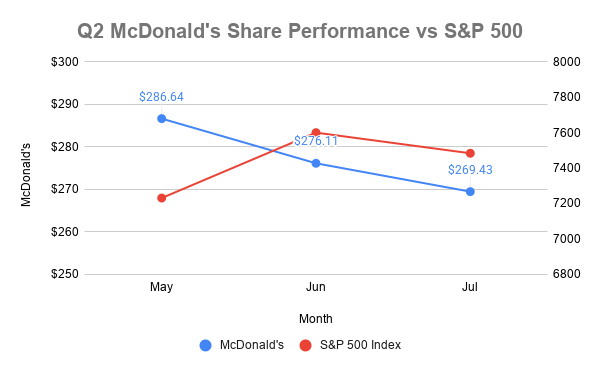
Key Financial Highlights
For Q2 2026, McDonald’s generated $7.10 billion in revenue, up 4% year over year, or 2% in constant currencies. Operating income increased 3% to $3.34 billion, while net income rose 5% to $2.36 billion. Diluted EPS increased 6% to $3.32. Excluding restructuring charges, adjusted EPS was $3.38, also up 6%, or 5% in constant currencies.
Global Systemwide sales increased 5%, or 4% in constant currencies, to approximately $37 billion for the quarter. Global comparable sales increased 1.3%, consisting of:
- U.S.: +0.8%
- International Operated Markets: +1.5%
- International Developmental Licensed Markets: +1.9%
For the first six months of 2026, revenue increased 6% to $13.62 billion, operating income increased 7% to $6.29 billion, net income increased 5% to $4.35 billion, and diluted EPS rose 6% to $6.10.
Franchised restaurant revenue increased 4% to $4.39 billion during Q2, while Company-owned restaurant sales increased 3% to $2.53 billion.
Strategic Initiatives and Market Performance
A central development during the quarter was management’s decision to increase its focus on the U.S. business. CEO Chris Kempczinski said McDonald’s sees an opportunity to “raise the bar” and accelerate performance in its largest market. The company appointed Skye Anderson as President of McDonald’s USA, citing her operational discipline, system knowledge, and ability to drive change.
The strategic priorities remain consistent with McDonald’s broader playbook: value leadership, marketing, menu innovation, digital engagement, loyalty, and operational execution. Management said the playbook continues to work globally, but acknowledged that U.S. execution needs to improve.
Loyalty continued to be a major area of strength. Across 70 markets, trailing-12-month Systemwide sales to loyalty members increased more than 20% to $40 billion. Ninety-day active loyalty users increased 13% to nearly 220 million, indicating continued growth in McDonald’s digital customer base.
Internationally, performance remained positive but moderated. Most International Operated Markets produced comparable-sales growth, led by Germany, Australia, and the U.K., although France was a drag. International Developmental Licensed Markets were led by Japan, with all geographic regions positive overall, although China posted negative comparable sales.
Challenges
The biggest challenge in Q2 was the slowdown in U.S. traffic and comparable sales. U.S. comparable sales increased only 0.8%, compared with 2.5% in Q2 2025. Growth was driven by higher average check and favorable product mix, while comparable guest counts were negative. This suggests that pricing and mix contributed more to sales growth than increased customer visits.
Global comparable-sales growth also slowed to 1.3%, compared with 3.8% in the prior-year quarter. International markets remained positive, but France and China were specific areas of weakness.
Cost growth was another pressure point. Other SG&A expense increased 19% to $706 million in Q2 and 16% for the first six months. Interest expense increased 5% during the quarter. McDonald’s also recorded $52 million in pre-tax restructuring charges related primarily to Accelerating the Organization, up from $43 million in Q2 2025.
Although operating income increased, its 3% growth rate was below the 4% revenue increase, illustrating some pressure on operating leverage during the quarter.
Outlook
The release does not provide specific quantitative full-year 2026 guidance, but management’s messaging points to a clear priority for the remainder of the year: improve U.S. execution and customer traffic while continuing to scale the broader McDonald’s growth model globally.
The appointment of a new U.S. president signals that management views performance in its largest market as an area requiring more urgency and operational discipline. At the same time, the continued expansion of loyalty, strong franchised margins, and positive international comparable sales provide support for the broader business.
Key areas to monitor in the second half of 2026 include whether U.S. guest counts return to growth, whether the company can accelerate comparable sales without relying heavily on higher average check, the performance of France and China, continued loyalty-user growth, SG&A cost pressures, and the effectiveness of management’s efforts to strengthen execution in the U.S.